CASOON Open Source
Route every prompt to the cheapest model that can handle it.
llmux is a local, OpenAI-compatible proxy between your tools and your providers. It classifies each request, applies privacy, capability and budget rules, and forwards it to the cheapest viable model, provider and cost tier.
git clone https://github.com/casoon/llmux && cd llmux && npm ci && npm run build && cargo install --path .cargo install --git https://github.com/casoon/llmux$ curl -s localhost:3456/v1/chat/completions -H 'content-type: application/json' -d @architecture.json | jq '{model, usage}'
{
"model": "echo-pro",
"usage": {
"completion_tokens": 72,
"prompt_tokens": 19,
"total_tokens": 91
}
}- task types, from simple_text to architecture
- 5
- cost tiers in the model catalog
- 5
- read-only Stats API endpoints
- 8
- Rust tests passing (cargo test, 2026-09-27)
- 101
What it does
Intent-based, tier-aware selection
Each task type sets a quality floor (min_tier). Among the models that clear it and fit the context window, llmux estimates the cost of this request and takes the cheapest.
Privacy and capability filters first
Secrets matching block_cloud_patterns force local-only routing. Requests with tools, JSON schema or images only reach models that declare those capabilities.
Budgets that degrade instead of failing
Daily and monthly spend is summed from the SQLite log. Above configurable thresholds the tier ceiling drops; a 402 comes only when even the cheapest model would exceed the remaining budget.
Retry, fallback, cache and a log you can query
Transient errors retry with backoff, exhausted providers fall through to the next candidate, identical requests come from the cache, and every decision lands in SQLite with its policy result.
Embedded dashboard
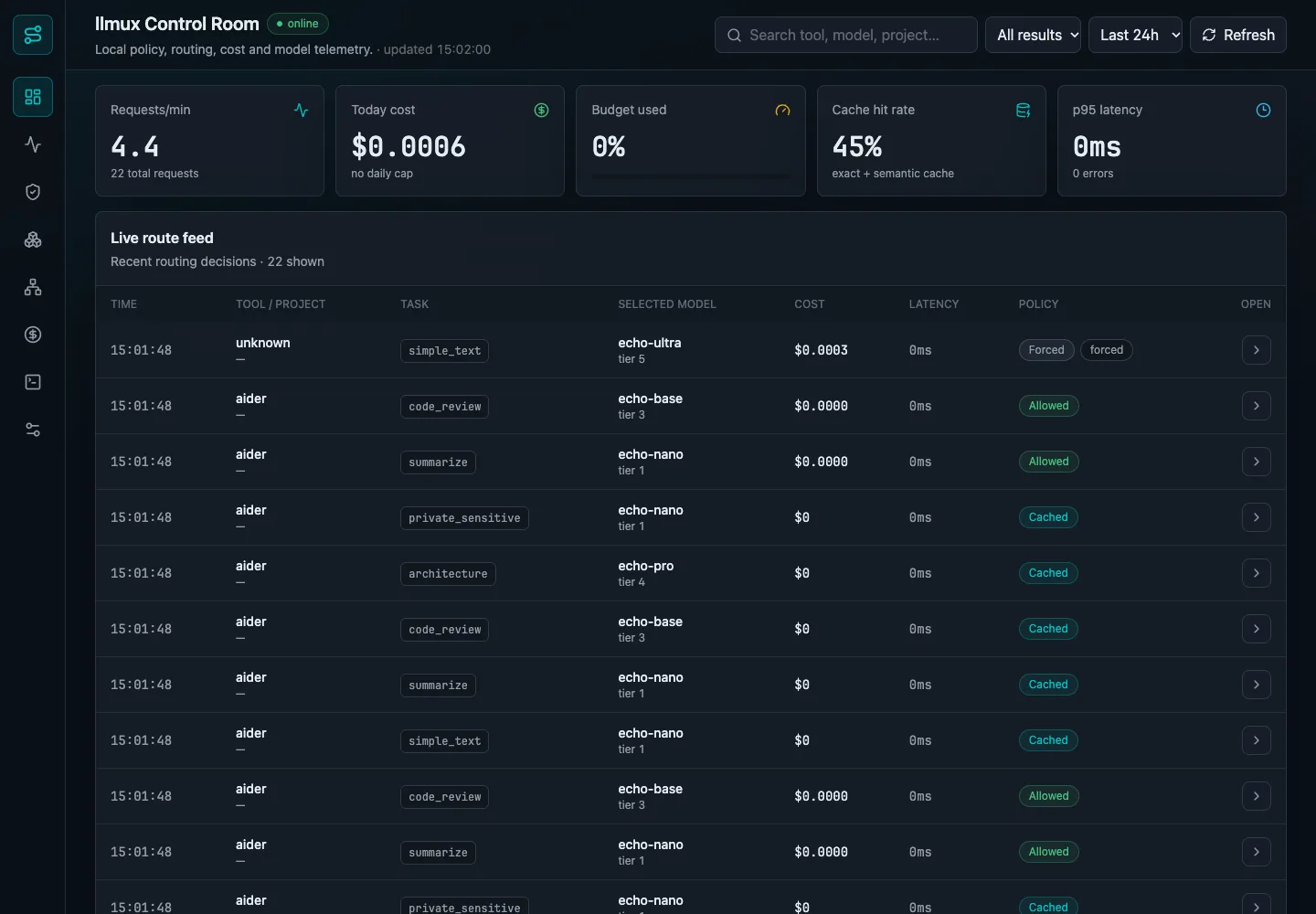
The binary serves a read-only dashboard at /, fed by the Stats API. Captured from llmux --demo after 22 requests.
Real output
All examples →{
"allowed": 4,
"cached": 1,
"degraded": 0,
"fallback": 0,
"forced": 1,
"forced_rejected": 0,
"local_only": 1,
"rejected": 0,
"top_rejection_reasons": []
}Policy counters from GET /api/stats/policy after the six showcase requests. Every example on this site was captured from llmux --demo with examples/capture.sh.
examples/stats-policy.outQuickstart
Try the routing without any keys: demo mode answers every request with the built-in echo provider and an in-memory database.
- Build and install the binary (see above), or run
cargo run -- --demoin a checkout. - Start
llmux --demoand open the dashboard athttp://localhost:3456/. - Point any OpenAI-compatible client at
http://localhost:3456/v1, or send a request with curl.
llmux --demo            # built-in echo provider: no keys, no network
# dashboard: http://localhost:3456/

curl -s localhost:3456/v1/chat/completions \
  -H 'content-type: application/json' \
  -d '{"messages":[{"role":"user","content":"explain the architecture trade-offs"}]}'