Invoices with ZUGFeRD
Turn invoice JSON into a PDF/A-3 with embedded XML, check it with the Mustang validator and see what happens when the data is wrong.
Deutsche Fassung: Tutorial auf Deutsch
Since 2025, businesses in Germany must be able to receive e-invoices; they must issue them from 2028 at the latest.
Source: § 27 (38) UStG; BMF letters of 15 October 2024 and 15 October 2025 (as of 11 October 2026)
Show chart data
| Item | Kind | Start | End | After |
|---|---|---|---|---|
| Receiving mandatory | Milestone | 2025-01-01 | ||
| Paper and other formats allowed | Phase | 2025-01-01 | 2026-12-31 | |
| only up to €800,000 prior-year turnover | Phase | 2027-01-01 | 2027-12-31 | Paper and other formats allowed |
| EDI procedures allowed | Phase | 2025-01-01 | 2027-12-31 | |
| E-invoice mandatory for all | Milestone | 2028-01-01 | only up to €800,000 prior-year turnover, EDI procedures allowed |
A ZUGFeRD invoice is a PDF/A-3 that carries the same data a second time as XML (UN/CEFACT CII, profile EN 16931). For VAT, the XML is the leading part.
typstgen builds the XML from the same JSON data the invoice template renders. It recomputes lines, VAT per category and totals first; if the JSON states different numbers, the build fails, since otherwise the PDF would show something else than the XML. Covered: standard and reduced rate, 0 %, exempt with a reason, and reverse charge.
Not legal advice
Dates as of 11 October 2026: § 27 (38) UStG, BMF letters of 15 October 2024 and 15 October 2025. Check the current rules or ask your tax advisor.
Create and check an invoice
1. Document. Two lines: load the template, pass the data. The package lives in the
typst-business-templates repository under packages/local/business-templates/0.1.0;
package_path in typstgen.toml points to it.
#import "@local/business-templates:0.1.0": invoice
#invoice(data: json("/rechnung.json"), company: json("/company.json"))
2. Compile. --zugferd and --company build the XML from the same data and embed it as
factur-x.xml.
$ typstgen compile rechnung.typ --pdf-standard a-3b \
    --creation-timestamp 1737500000 \
    --zugferd rechnung.json --company company.json
rechnung.pdf
3. Check. Mustang checks the PDF/A-3 and the XML against EN 16931.
$ java -jar Mustang-CLI-2.26.0.jar --action validate --source rechnung.pdf
… Parsed PDF:valid XML:valid … Profile:urn:cen.eu:en16931:2017 Version:2 … Errors:[]
4. When the data is wrong. Every problem at once, each with the field that fixes it:
error: ZUGFeRD invoice:
recipient.address.country: unknown country, set recipient.address.country_code (ISO 3166-1, e.g. "DE")
items[0]: unit "Kisten" has no UN/ECE code, set items[0].unit_code (e.g. "C62")
items[1]: total 1.00 does not match quantity × unit price = 11200.00
The result is a valid ZUGFeRD PDF in the EN 16931 profile; veraPDF reports PDF/A-3b compliant. Mixed VAT rates, reverse charge and an exempt invoice were checked as well.
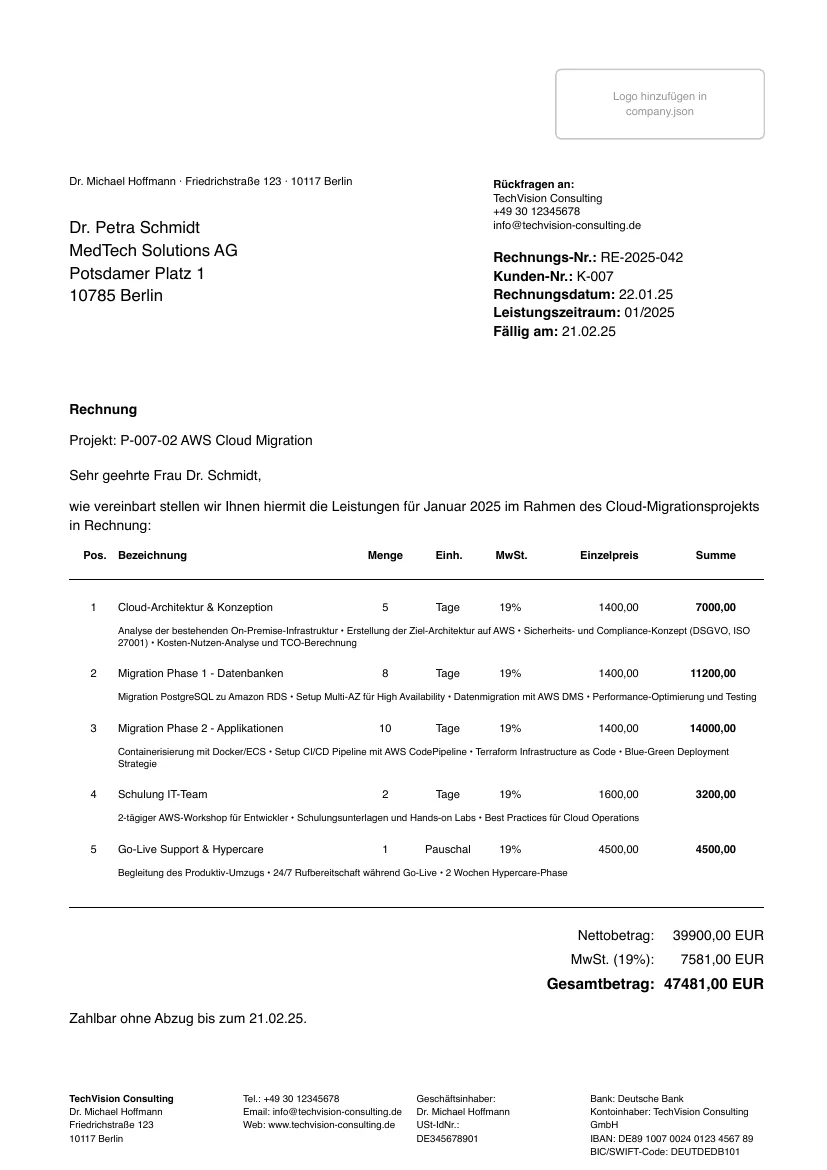
Invoice from the “it-consultant” example; the example company has no logo.
Check before you send
Check invoices with a validator such as Mustang before they go out. The reference for all of this is E-invoices; XRechnung for public-sector buyers is covered there as well.
Next: Archive, verify and sign.